Watching music


Before any sound recording technology is made available, music is watched as much as listened to. This masks the fact that music is a pure acoustical form that demands the right to be attended to alone in its own sensorial realm. Goethe says in his Wilhelm Meister, that “True music is for the ear alone. I want to see anyone I am talking to. On the other hand, who sings to me must sing unseen; his form must neither attract nor distract me.” Does this mean that Mr. Goethe would be glad to collect CDs without bothering going to any concert?

Arnheim talks about this “most fundamental contradiction between visual and aural phenomena.” When we watch a music performance, we are watching the process in which music—a specific form of sound—is produced; but we are not necessarily watching a visual correspondence of what we hear. “Our eye shows us an arrangement of the musicians on the platform that is only occasionally characteristic of the music performed (since the violins who sit in front have by no means always the lead). The musicians are always seen, even when they have rests. This gives an impression of comfortable inactivity alternating with playing.” A more detailed description is copied as follows, for I really love his style of writing.

No disparity between fifty waiting men, from the violins in front to the kettledrums at the back, and the one modest flute which perhaps has to start the piece all alone. The flute, now sounds really as tremulously little and lost in nothingness, as was the composer's intention when he wrote the beginning as a solo. The flute plays, and no longer sounds like the isolated part of some nice man 'in the act of playing' whose appearance never changes; in some very exciting way, everything static has vanished from the performance. Time passes most perceptibly; nothing of what has just been is left the next moment; only the course of the single line of melody exists; all the action is pure movement. The flute is quite alone and suddenly the oboe joins in, likewise merging from nothingness, unexpected and coming to life only at the moment the composer brings it in, not previously present as 'counting bars'. And so the work is gradually built up. Whoever has nothing to play vanishes completely out of the picture, simply does not exist. If the piece is adagio, then the whole world is adagio; if it is allegro then nothing exists but the rushing course of the rapid motion-no men sitting waiting or suddenly stopping in the middle of the situation. (RAS 145)

This argument makes sense. When I open my eyes in concerts big and round—there are people with eyes closed as if they were in a state of trance—I do find the movement of musicians misleading. These movements are only relevant if one wants to associate peculiar visual information, that is, a specific musical instrument, as well as a specific way that it is played, with a specific sound (the timber). But strictly speaking to appreciate the music such knowledge is not required. And the more one is unable to grasp music in its aural form the more one is inclined to register its source of production—as if the knowledge, that is, the visual depiction of it can be somewhat helpful. Often, when I notice that a member of the orchestra picks up his instrument in order to be ready to play his part, I have an anticipation of the coming sound. Such anticipation is entirely non-musical. If the musical procession prescribes it, you cheat by knowing the answer beforehand; if it doesn’t, you ruin the surprise. Likewise, many would agree that in order to appreciate the beauty of opera one does not have to understand the language it is sang—it is a fact anyway.

But somehow I find such knowledge desirable. One has the expectation—speaking for myself here—that such knowledge would render the experience more complete, that it would give it more depth. This expectation, again to quote from my own experience, is deceptive. Understanding Italian does not make your Puccini more delicious; it does the contrary, since now you agonize over the extreme vulgarity of the libretto.

The act of going to concerts must be explained otherwise. Undoubtedly, in the presence of human agents—and the ritual itself: expensive subscription, dress code, entering into a sacred locus, etc.—we are more assured of the music’s artistic quality. This is what Benjamin calls the aura. It has to be here-and-now and it is not technically reproducible. But does it pertain to what music really is? The simple answer will be no. Otherwise, we would be only pretending that we like Mozart, since there is no chance we can actually meet him. But an art is never simply an art; it is always associated with certain modes of consumption. What is important is that although these modes of consumption are historical, therefore contingent, their presence at any given historical moment is strong. It is impossible to approach music without any mode of consumption. Go to concert, as well as listen to Pandora, is just one of them.

There is no denying that popular music caters to the need of the mass; it makes itself accessible ad infinitum by adapting to a common denominator of its audience. But that is not to say the classical music (I hate this word) never wants to appeal to the mass, or cultivates its own cult. On the contrary, I believe composing for our contemporary musicians has become a task characterized by a constant negotiation between musical heritage, individual talent and intended reception.


edit
The profound originality of being a good for nothing


I Vitelloni is, according to Bazin, a film that has a “profound originality” — that doesn’t mean much, since Bazin uses the term to a lot of films he chooses to write on. But it is indeed an important film that marks, along with several others, this transition of the first phase of Neorealism aesthetics to another, one more diversified and of individual paths.
It is quite refreshing yet absolutely futile talking about where does the Neorealism ends. Umberto D is often the official answer. But that puts the first two films of Rossellini’s religious trilogy into an awkward position. And isn’t Umberto D. an example par excellence of Zavattini’s openly claimed neorealist aesthetics? Let us rather not to demarcate a clear line and instead focus on what differs this neo-aftermath from its predecessors. But even here we hear different voices. Bazin argues,
Is not Neorealism primarily a kind of humanism and only secondarily a style of filmmaking? Then as to the style itself, is it not essentially a form of self-effacement before reality? (I 29)
This apparently makes sense, and even eloquently so. But I would argue it is very misleading, and contradicts to Bazin’s own writing.
Realism, let me repeat, is to be defined not in terms of ends but of means, and Neorealism by a specific kind of relationship of means to ends. What De Dica has in common with Rossellini and Fellini is…the pride of place they all give to the representation of reality at the expense of dramatic structures. This is a “phenomenological” realism which never “adjusts” reality to meet the needs imposed by psychology or drama. The relation between meaning and appearance having been in a sense inverted, appearance is always presented as a unique discovery, an almost documentary revelation that retains its full force of vividness and detail. Whence the director’s art lies in the skill with which he compels the event to reveal its meaning — or at least the meaning he lends it — without removing any of its ambiguity. (II 87)
I will not go to great length about this. Let me simply say, I agree with the neoformalists that this “form of self-effacement” is just another form in disguise, and it acquires its realist value largely because it is perceived as something formally new. In other words, as Yuri Tsivian put it in such clarity, “Realism is an effect created in one’s mind, not a property inherent in the real world or its image.” The fact that Italian people soon get tired of them is a proof of the novelty dimension of this aesthetic. Besides, whenever Bazin makes his analysis, it is clear that what concerns him is the style, before anything else. As for humanism, isn’t a local breed in the 1930s, by Renoir, Carne, Duvivier good enough? What is so exciting about an Italian version?
It is again in style that neorealists eventually split and go their respective paths. I think Bazin wouldn’t disagree that both Fellini and Rossellini are still interested in depicting humanism. In fact he says, “I tend to view Fellini as the director who goes the farthest of any to date in this neorealist aesthetic, who goes even so far that he goes all the way through it and finds himself on the other side.” (87) But again what is the common denominator of this new stage is a discernable effort to negate storytelling and character development. Now that is something really unheard of. And it is exactly here the talent of the filmmaker is put to maximum test — how to express anything at all without the formula? How to gratify an emotional and sometimes intellectual involvement of the audience? It is indeed a complicated situation. Compared to early neorealist works this distinction becomes clear: it doesn’t come at the most superficial level. The protagonists of Vitelloni and Ladri are both bounded by their social surroundings, reduced to a state of immobility, to which they struggle for a denouement, in vain. They are both personal stories of lost and found, and a bit sentimental at times. What is the real difference? First I will still quote Bazin,
Events do not “happen” in Fellini’s world; they “befall” its inhabitants; that is to say, they occur as an effect of “vertical” gravity, not in conformity to the laws of “horizontal” causality. As for the characters themselves, they exist and change only in reference to a purely internal kind of time. (II 84–5)
This, of course, refers to films other than La Strada (1954) or Nights of Cabiria (1957). These are masterweepies in a different way. It shows that Fellini, unlike some filmmakers, can tell a coherent story, and even too perfect (Bazin says) to be anything exciting to write about. But it is the way Fellini handles a non-coherent story that ultimately eliminates any doubt of his artistic intention and manipulation. Bazin says, in his usual perceptive way, that the characters in Vitelloni do not evolve; they mature. He also makes the observation that it is through the most trivial activities that they “reveal themselves to us in their innermost essence.” Take for instance, the meeting of Franco with the railway boy. It could be argued that narrative-wise it leads to Franco’s final departure by train. But there are some arrangements that make the episode unique and strangely touching. The first of these is that they meet at 3:00 am. It’s not only because they like to show deserted streets that they never let their characters go to bed. In L’Avventura, Sandro actually confessed that they never want to go to sleep — they will do anything except sleeping. When the boy says he always get up at three his eyes shine like night stars. That’s a sacred moment for me and I don’t quite understand why. Franco asks what kind of work he does for the railway, he simply answers “lavoro” and for a moment Franco loses his thoughts contemplating this world of jobs that remains a mystery to him. Is this situation banal? Yes, the way I describe it. In order to describe it correctly I would have to suggest you to read works such as Jude the Obscure, etc. What Fellini succeeds here is really the essence of literature, without all the boring techniques. It lifts the veil of a contemplative mood, of a world that is strangely non-consequential for us to cast a glimpse there; and it disappears again momentarily.
And the second fact is the boy. Symbolism is at best with certain casualness. Only seven years ago we saw Franco Interlenghi in Shoe Shine (1946), where he was a boy himself. That film, which one could argue shows Neorealism in its adolescence, has all the charm of boyish innocence. It would be interesting just to look at what roles Franco played to see how this movement evolved and diversified. How different the same Franco looked in Antonioni’s I Vinti! What an anguished body compared to those shining eyes of two boys on a white horse!
The story of Fausto is indeed a classical moral tale. But what is incongruent with his image of an incorrigible womanizer is his feeling for Sandra. Does he care about her? From the fact that he was ready to take off when he learned she is pregnant, one would be tempted to say no — and he never shows any affection for the baby. Nevertheless when he sees Sandra in distress he sobs (in the garden). He seems to feel genuinely for her. Not only is he capable of sympathy (Kundera’s Thomas is a most appropriate reference here), he is of a disposition that feels more than average. The power of this characterization comes from this apparent dichotomy, for it is absurd in the eyes of a conventional psychology, which applies to minds that stopped development in the age of 25. Am I exaggerating? Bazin puts it this way, “such anti-psychological cinema goes further and deeper than psychology; it goes to the protagonist’s soul.”
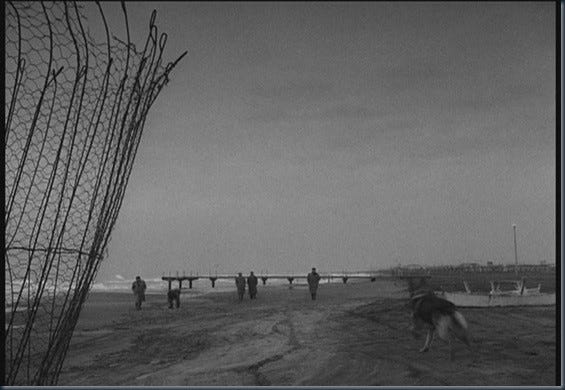
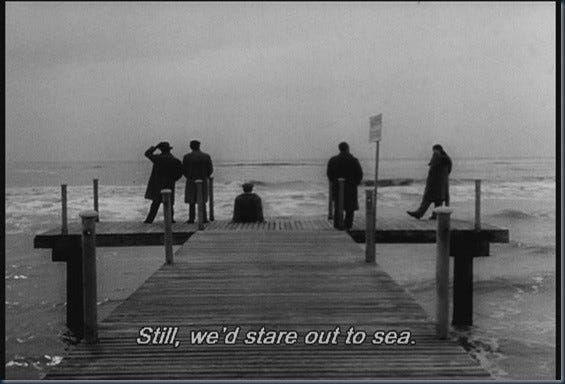
The case of Alberto is in a different category. He is an energetic and hilarious clown, not the first for Fellini, and certainly not the last. He is an incredibly sad Pagliacci. His development can be seen in Lattuada’s Mafioso(1962), where he becomes Antonio Badalamenti, and establishes himself as a model technician in an automobile factory in Milan, where he has got a lovely wife and two daughters with beautiful names. But when he returns to his hometown — Sicily that is — he finds, not to his surprise, his fellow vitelloni are still strolling the beach, talking about “alienation” (not seriously) and the shape of woman’s tits (seriously).
The connection is amusing; it is at once casual and deliberate. Of course Lattuada and Fellini collaborate in Variety Lights. And almost in any national cinema commercial films share a same pool of available actors with art films — Mastroianni is not only a symbol for Antonioni, Visconti, but also for Pietro Germi, for Mario Monicelli. But what is peculiar in Italy, or at least at this period, is that these commercial films make ample references to the so-called artistically successful films — that is, they have international critical claim — which are singled out of a national cinema.
Fellini’s taste for woman is definitive. It is perhaps what we know the most of him as a person. Fellini casts women as typage. He does admire angle faces — Claudia in Otto e mezzo; but he is also attracted to horribly voluptuous figures with thick eyebrow and vicious smiles. These are woman from the beach, the physical dimension, the flesh of his life. And they form a contrast with the light footed, gentle, ephemeral figures that descent from heaven. In between we also have the always victimized, sobbing and golden-heart woman on earth. From what I understand, he didn’t use Massina here because he finds her too happy, a bit confusing but nevertheless optimistic. This is the image of Massina in Europa 51 — she has yet to acquire that sad look in La Strada.
For Fellini cinema is not a craft, but a personal expression. His talent consists of this magical transformation from the former to the latter. Many take this as fantasies, isn’t this characterization itself a proof our mental poverty? Bazin writes, “without our noticing the world has moved from meaning to analogy, then from analogy to identification with the supernatural.” (II 88)

edit

Popular Posts

Blog Archive