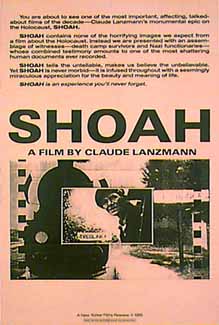
Shoah

The one thing that I don’t like of documentary is its pseudo-authenticity. Everybody knows that when documentarists set out to make a documentary, it is about something—that something is already there in the head, he just needs to actualize it—Michael Moore, for example, did not form his opinion of Mr. Bush only after the shooting of Fahrenheit 911. In a sense, all interviews, or presumably objective accounts of events are nothing but the result of careful manipulation. The art of documentary, then, relies on partly how to make these manipulations inoffensive, if not all together invisible.

Nevertheless, I was quite annoyed by the way Claude Lanzmann pressed or coaxed his interlocutors to say those thing he wanted to hear. In fact, he treated each episode in such a way that a central theme, or even a label, can be easily recognized. His persistence in more details, in questions such as “what exactly does it look like” or “how long, how wide” diverted his interlocutors from immediate emotional response. Thus he was able to get those details, and use them to evoke a deeper emotional response in the audience. In many occasions, he assimilated his point of view with that of his interlocutor; in other occasions he made it look like that he was indifferent to the matter in its moral sense, but rather, only interested in some small details. Either way he created the illusion, at least for his interviewer, that he somehow sympathized “their” view of the world. When speaking with former SS officer, he adopted a German way of speaking, not only the language; when asking question in front of Polish villagers gathered for the birthday of St. Mary, although his ultimate purpose was to illustrate how indifferent these people and the Christian church were to the Jewish people, he made it sounds like some village gossips, which he couldn’t help wanting to know more.

There are numerous instances like this. I believe nobody will deny the strong presence of manipulation in this documentary (After nine and half hours of watching, I am sure you will learn something new about the trick of persuading, if you have already known everything about the Holocaust). Nevertheless, back in those days (1985), it did work. Even today, for less discriminating audience, it will continue to work very well. In fact, it is a treat for those who still think Schindler’s List is all that you can say about the Holocaust.

That name brings up my favorite scene in Woody Allen’s Mighty Aphrodite. One simple minded onion-farmer-turned-boxer wanted to find a good girl to bring home. Woody Allen recommended his new acquaintance (in fact, the biological mother of his adopted son ), a prostitute-plus-porno-star. Here goes their conversation:


Boxer: You said she was an actress? She’s been in some films?

WA: She’s had a couple of good roles, yeah.

Boxer: She’s ever been in anything I seen?

WA: Hey, you didn’t see Schindler’s List?

Boxer: No, no.. that was… that was the one with the Jews and…who were the bad guys?

WA: The Nazis. The blond guy were the Nazis.


If we say Schindler’s List is too obvious in its purpose. Shoah, too, bears a hidden agenda. The question is: which one is a better picture? Now, normally people would say: Shoah, of course. But I am no longer certain. Shoah devised new way of depicting an unspeakable horror, but Schindler’s List is also representational in adopting a point of view which is common in many people. For most Chinese at least, this latter is perfectly all right.


edit

人海,太人海了


满城尽带黄金甲刚刚看过了,这么多年,从来没有在电影院看过张导的作品,想想也是有点说不过去。

从一个摄影师走到今天,张导似乎是划了一个圆圈,又回到了原点。对颜色的关注,在张导的影片中一直是存在的,但是发展到今天这个地步,确实已经成为一种执着。

有些人眼睛盲了,于是听觉变得异常发达;有些人不能说话,于是更多地注重对事物的观察。对颜色超级执着的结果,不免使电影其他方面的特性大打折扣,正所谓,一叶障目,不见泰山。

拍古装片不能光有场面和效果,有人在这里栽了大跟头,这个问题张导显然是认识到了,于是乎一力加强戏剧性,把大剂量的“戏剧性元素”注入场面和效果,具体的办法就是弄出一个“雷雨”的影院版。

“雷雨”恐怕没有什么不好,如果说“雷雨”不好,那么整个中国戏剧界只怕都要拍桌子,但是“雷雨”怎么移植到电影院里,还是要讲个方式方法。现在的状况,好比“雷雨”的身上长出一支“指环王”的胳膊,不免看起来有些怪怪的。

此外,这个所谓的悲剧要传达怎样的讯息?我有点不得要领。古人云,无规矩,无以成方圆。在影片里,规矩被阐释为自然法则,而偷情,则是对这个规矩的玷污,如同影片最后一幕所示。但情难道不也是自然法则之一?古人并没有说方圆究竟怎样,只是说规矩乃是方圆的尺度,由矩、规而得方、圆。人定下的方桌,不也要建筑在由情所堆筑的圆台上?礼和情的冲突,古人一直试图调和,最好是发乎于情,止乎于礼,而不是一味的镇压。只是情的壮大,有一个不受礼束缚的倾向,“雷雨”的悲剧要素,就是在这种情况下对礼的再认识。这个,我觉得影片反思的还不够。

这些冷言冷语,也许对于张导的一番苦心是不公平的,毕竟现在的观众也许已经忘了曹禺,再普及一下绝对不应该是坏事。我真正对于张导的不满,也确实不在这个方面,而是其它两点,演员指导,场景调度。

某些演员普通话说不清楚,这个我忍了;但是表演不到位,场景调度马马虎虎,只能是导演的责任。整部影片,不论是从叙事,剪接,还是对摄影机的运用,都没有看出任何新意。让我举出例子,那是很难,因为平庸是没有办法例证的。

但是话又说回来,有那么多大大小小的事情要张导操心,那么多场景设计的细节,要一一核实,那么多盆黄菊花,要仔仔细细码在场子上,那么多标枪,都要一一涂成金色,还剩下多少时间来考虑表演和场景调度?不是说张导没这个能力,我估摸他是在想,在这些事情上,我就算是用了心,你观众能看得到吗?能给我鼓掌吗?

人海战术,这个一向是中国特色,现在用在屏幕上,可谓是构成了一个“人海美学”。其大意是,无论是怎样无聊的事情,有十万个人来做,那就成了壮举;无论是怎样无聊的东西,同时在你面前堆上十万件,那也就成了艺术。

一万名将士被屠杀了,尸横遍地,可是不知怎地,我觉察不到一丝残酷,因为这些人都没有面孔,没有名字,他们从哪里来?往何处去?为什么会死在这里?死,对他们又意味着什么?人海,毕竟还不是人性。


edit

L’important, c’est d’aimer


The relationship between filmmakers and their female stars has always been troublesome. This is not because, as one is led to believe, a female star is no longer capable of playing the role of wife, but that the combination is just too sensational for the couple. Camera, in the hands of an able director, becomes a paintbrush, a magnifying glass, a weapon to explore, to reveal the female body—and the mind behind it. This power is somehow strengthened if the relation between the director and the female in question is beyond professional contact. The analogy of painter and his model is pertinent here, since not only their tools resemble, their gazes have to reach the same depth behind the faces of those women before a true piece of art can be produced. In the light of this argument I would recommend every director to cultivate a certain degree of intimacy with his model—just for the sake of art. However, sometimes it might turn out to be a nightmare—here come the protagonists of our story.

Most of us on earth come to know Andrzej Zulawski through Sophie Marceau (You don’t know Sophie Marceau? Do you live on earth?). But other than the husband of a French film star, Mr. Zulawski has an indisputable professional background. He was trained at the prestigious IDHEC and worked as assistant for Andrzej Wajda in three films (1961, 62, 65). He also attended both Warsaw University (1961) and Université de Paris (1962-1964), so that he was not just a professional worker—he wrote most of his scripts. Like Polanski, he made his debut back in Poland. But his confidence in motherland was soon crushed by the banning of his second feature Diabel (1972). His third project, The Silver Globe (1987) remained unfinished for ten years—the team was practically disbanded by the authority. Understandably, in the end of 1970s he went to live in France, leaving all these unhappy memories behind.

L’Important, c’est d’aimer (1975) is his first project in France. It features Romy Schneider and brought her a Caesar for the performance (something every French actress covets for). Possession (1981) repeated the formula (the woman, the husband and the intruder triangle) and brought Isabelle Adjani the same glory. La femme publique (1984) didn’t make it. I have yet to see this film and understand why.

From 1985 onwards Zulawski mainly worked with Sophie Marceau, then a plump post-Boum teenager-turned-star. She made Police (1985) this year with Maurice Pialat, where her role is far from central, and she was certainly looking for something more ambitious, for instance, the role of Adjani in Possession. Hence L’amour braque (1985). It might have been the one if the jury was not already a bit tired of Dostoyevsky’s universe. Mes nuits sont plus belles que vos jours (1989) features more nudity from the part of Sophie, but that didn’t work; either was La note bleu (1991) and La Fidèlité (2000). By this time, everyone knew that the problem is with the husband. Since besides those Zulawski films, Sophie was shining everywhere: Fanfan (1993), Braveheart (1995), Anna Karenina (1997), Firelight (1997) and finally, even a Bond film, The world is not enough (1999). Although these films are not necessarily artistic, or have Sophie as a central character, her performances (or simply appearances) are much more enjoyable than the way Zulawski had been using her for years. It was no surprise then in 2001 we heard that Sophie left him for good.

Conversely, without Sophie, Zulawski seems to fare better. Szamanka (1996), a film shot in Poland, was again an impressive piece of work, reminding us of the power revealed in his earlier Possession. Although Zulawski’s themes remain always the same, only these two are constructed above the level of comprehensibility, a quality that he does not seem to care very much. What does he care then? It seems that the title of film I saw tonight can best capsulate it: what counts is to love. Not only Zulawski regards love as the most noteworthy thing in the world, it is to his understanding that we always have to fight for it, and mind you, fight real hard. Consequently, Love becomes Violence at Zulawski, and he seeks to explicitly convey this sense in his films, either by actual violence (somebody gets beaten up in most of his films), or a sexual violence, which are most of the time fortuitous, traumatic.

Michael Atkinson pointed out in his "Trouble Every Day: From Amour Fou to Primal Scream: Inside the Movie Madhouse of Andrzej Zulawski" (Film Comment January 2003, Vol. 39 pg. 38-41), that “Not much has been written about Zulawski, and virtually none of it in English, but when he is described at all it is as a simple hyperbolist.” He was true. And his article does not add much to this total vacuum by giving us a detailed analysis of Zulawskian aesthetics, although it seems that he does see those films and enjoy them to a certain extent. Actually, I imagine Zulawski to be a prize subject of film study: what a splendid mixture of absurdity, violence, female exploitation, among others!


edit

EVD是否会重演SVCD失败历史?

中国消费电子产业最近有一个不大不小的新闻,那就是全国最大的家电连锁经销商国美电器宣布与其他伙伴厂商组建中国EVD产业联盟,并由国美总裁黄光裕出任主席,原先的EVD“旗手”张宝全则担任秘书长一职。
EVD标准自推出以来,大大小小的新闻也有不少,总归是造成了一定的声势,但是在如今蓝光和HDVD正处于上市之初,还没有人可以断言鹿死谁手的阶段,EVD又掺和进来,这种搞法的究竟前途如何呢?普遍的质疑是,EVD恐怕又要重演SVCD的失败历史。存储时代撰文如下:

中国大陆官方努力推动的增强型多功能光盘(Enhanced Versatile Disc;EVD)终于随着集结多家碟机厂推出52款EVD产品而可望正式与消费者接触,但它究竟是否能成功,还是重演数年前大陆推动SVCD规格的失败历史?国际大厂的态度仍是重要关键,如果没有商业大片支持,号称拥有高画质且低价位的EVD恐沦为聊备一格。
SVCD是怎么失败的?在DVD推出不久而全球慢慢流行后,大陆仍旧以VCD播放机为主,大陆官方为了扶植大陆碟机厂业者,并减少高昂DVD权利金的支付,推出画质约达DVD影片3分之2的SVCD规格。对碟机厂而言,只要更换处理视讯和音讯的编码器就能打造出SVCD播放机,换言之,碟机上的读写头差异不大,就是要以VCD碟机架构要和DVD抗衡。但SVCD并未获得国际影业大厂支持,有发行该规格影片的只有亚洲片商,到最后沦为聊备一格的产品,但并无多少片源可观看,消费者还是满足于大量且易取得的DVD影片。
再看现在大陆力拱的EVD,在2003年11月发表,除希望让大陆厂商摆脱市场主流的DVD的专利授权金,更希望能与2大蓝光阵营抗衡,并避免高额授权金,同时还可建立大陆自主的本土碟机产业链。
事实上,EVD与SVCD的模式一样,仍旧是打着用DVD碟机架构,更换编码器后方便大陆碟机业者生产,减少制造与设备更换的费用,提供能接近蓝光高画质光盘技术的算盘。然而,这次的戏码很可能和SVCD一样,因为现阶段EVD的影片来源只有少数大陆片商,国际影业大厂已经在蓝光2大阵营规格的影片推出上费尽心思,要再推出商业大片的EVD版本机会不大。
另外,虽然EVD的优点是硬件、规格自主性高,不受国际大厂控制,但其标榜的高画质能否与蓝光阵营画质比拟存在着疑问。而EVD碟机的低价格、低成本诉求固然是一项优势,较平均售价87美元的DVD碟机多一点点,但蓝光阵营的碟机生产成本现阶段虽数倍于此,可是未来可望藉由中国台湾、日本、南韩碟机厂量产实力的奥援,提高良率与出货量让成本大幅下降,要与EVD的低成本抗衡并不难。
在这样的情况下,连部份大陆碟机厂都质疑EVD联盟2008年全面停产DVD,转而生产EVD的诉求,大陆官方与碟机业者为甚么要努力连手推动EVD呢?主要的着眼点是有机会在较昂贵的次世代蓝光产品于大陆普及之前,以较低价格切入已经受到高画质电视热卖洗礼的大陆市场,只要能够拿下3~5成的市场,外商要进军大陆影片光盘市场就不得不考虑EVD规格的存在,EVD若有一定程度的成功,不但能填补大陆消费者透过高画质电视观赏影片来源的需求,也造福了大陆碟机产业,并间接使大陆影视产业受惠,也是大陆历来的政策方针,不希望受制于外国,要建立自主性。
照大陆EVD产业联盟秘书长兼金典集团董事长张宝全说法,大陆每台出口的DVD碟机需支付国际大厂16~19美元的专利权金,不少业者因此相继倒闭,故当务之急是加速发展EVD产业。不过,EVD碟机如果要提供DVD播放功能还是得支付权利金,若无则又无法取代DVD的地位,消费者要的是不会被淘汰且质量好的产品,EVD还没有大量普及之前,恐怕会先被目前主流DVD和未来新宠次世代蓝光夹在中间,变成高不成、低不就,缺乏国际大厂支持,与SVCD一样沦为二线规格,值得未来谨慎观察。


此文说的再清楚不过,但有几点我以为还是值得补充:
1。视频存储技术现在是处于一个指数发展的阶段。录像带的推出,使得电影真正进入家庭,对产业有深远影响。虽然录像带的质量和胶片天差地远,但是一旦启动这个指数发展进程,赶超只是一个时间问题。好比当年第一代PC机,固然可以被IBM主机小视,二十年后,个人计算机的性能已经远远超过当年的主机。录像带统治持续十来年之久,而DVD的生命周期则明显缩短,很多机构和个人,刚刚辛辛苦苦建立起自己的DVD收藏,还没来得及把VHS全部甩掉,就面临再次洗牌的局面。不论是蓝光,亦或是HD-DVD,显赫的时间只可能是更短,而不是更长。
2.在这种认识指导下,对于产业界人士,目标也许不是令自己的标准成为永恒,也不是,特别是对于中国厂商,令自己的标准成为世界唯一,而是适时适地跟随产业浪潮,并且从中寻找自己的盈利点。SVCD那算是失败么?固然,这个东西只在中国境内使用了,以后也不会有人再用,但是东西已经生产了,也卖了,那就很好。而且不用给外国人专利费,盈利点多出去一大截。东西好不好,是不是一流的技术,和卖不卖的动,那完全是两码事,任何一个有销售经验的人都是知道的。
3.当年的SVCD之所以没有更加普及,绝对不是技术不够好的原因。销售渠道,片源,对市场的把握都是重要原因。有理由认为,经过上次的演习,现在大家更知道应该怎么去做,而且会做得更好。EVD如果说不会大红大紫,至少也会达到或者超过当年SVCD的规模。
4。中国现在的市场,固然小部分有钱人已经投资了高清显示设备,但是把这一小撮人视为自己的市场目标,显然是不明智的。考虑一下一台这样设备的价格,再看看那怕是在城市里的人均收入,就知道,高清在中国的普及,还需要相当的时间。这个时间里,大家也不能闲着,或者跟在日本人屁股后面,替他们摇旗呐喊。就算是你很卖力,最后也只不过是给个苦力的价码。
5.另一种策略,就是正视国情,把握主动,此乃共产党的一贯方针(只不过到底国情是怎样,一般不让老百姓操心罢了)。EVD一方面能够利用厂商现有的生产设备,另一方面能够利用用户现有的显示设备,并且还提供上升的空间(据说EVD支持到1080i), 这个我看就足够三年之用了。三年之后情况怎样,还要看那时的形势。因为你现在没有投资蓝光生产设备,将来再投,也不算太晚的。况且,因为大陆现在显示出这方面的决心,日本人也有点摸不着头脑,大过年的,还要组团来中国考察,说来说去还是想要把中国这个市场争取到自己这边。这样一来,我们手里也算是有了一定的砝码,可以跟别人谈价钱。

edit

The lesson of Prescott


Prescott is the third revision in Pentium 4 production line which is itself the seventh generation of Intel x86 CPUs.

What the new Pentium 4 series feature is a Netburst microarchitecture. This Netburst was designed to be scalable from 1GHz to 10GHz. The first of the series is the premature Willamette, released in Nov. 2000, which suffers a lot of design inefficiency. Then comes in Jan. 2002 the famous and highly successful Northwood. In Sep. 2003, Gallatin , also known as P4 Extreme Edition, was marketed. The reason I say it is marketed is because it features almost nothing new, except larger cache and higher FSB. Prescott is yet another important milestone of the P4 series. It was released in Feb. 2004 and features major reworking in the design. However, the heat problem truncated very early its life span. Generating 40% more heat than Northwood, no Prescott has ever achieved 4 GHz.

For the first time in the history of VLSI manufacturing, we are made aware of the possible disturbances of the Moore’s Law.

While the manufacturing capability of IC is steadily progressing at an exponential rate (Prescott achieved 90nm for the first time in industrial mass production), the design was still dictated by marketing needs, rather than architectural considerations. It is well known that Intel relies heavily on the clock frequency to sell its product. Hence it is not surprise that they (used to) tend to prioritize the following task over any other: shrink the core size and raise the clock speed. However, this approach, while certainly applicable, faces two major disadvantages: transistor leakage and power density[1].

Since May 2005, Intel has released dual-core processors based on the Pentium 4 under the name Pentium D. Basically it is a double Prescott, the way Intel “makes lemonade out of lemons”. Hugh money was again dispensed to the marketing of the assumed advantages of dual-cores. Pentium D was first introduced in 90nm, and soon transplanted to 60nm (the PD9xx series). In the meantime, one crucial factor which contributes to the capacity of this (or any other electronic product) is constantly being neglected: the design.

The introducing of Core microarchitecture seeks to address to these problems. It is better designed and as a consequence, achieved considerable higher performance with an energy efficiency that Netburst series could not possibly dream of. It proves, to our surprise, how much the capacity of CPU can benefit from a better design. Naturally, now Intel is making the Core 4xxx series, which features a single core, instead of two. Although Intel does want to keep the dual-core marketing value, this move signifies to some extent that dual core is not absolutely necessary.

Same lesson can be derived from the development of GPU. The Crossfire and SLI solution does provide a means, for certain occasions where money and energy efficiency is not a issue, to boost the performance right here, right now. In the long run, however, better designed single GPU will constantly outperform the older generations (those of six months ago) of dual (or quad, as Nvidia is offering now) GPUs.

If the energy efficiency becomes a serious issue in the future, we might want to consider a feature that I call “dynamic clock range”. It is basically the possibility to adjust the clock frequency according to work load. Asus Mainboard has already implemented this (Non-delay Overclocking) and I hope this will become a standard feature in all MB vendors and supported by the OS vendors.


[1] Transistor leakage can be measured by the static power dissipation. Power density is the power dissipated per unit area.


edit

Children of Men vs. Singularity


Ever since the dawn of human history, art and science has been radically different in their imagination of the future. Running the risk of being over-simplistic, we may conclude that science is always optimistic, looking forward to greater achievements, whereas art tends to be pessimistic, nostalgic to the good old primitive days.

Recently I had the pleasure to watch one of the “contenders for Oscar” film called the Children of Men. Its plot basically revolves around a mysterious infertility problem which plagues human species in the year of 2027. The film starts with a news broadcast of the tragic death of the “youngest man on earth”, aged 18, where everyone is stunned and some, mostly women, cry. Understandably human being is never completely out of hope. A black woman, illegal immigrant as they call it, is miraculously (what a depiction of Virgin Mary) pregnant. Political parties, as you would expect, want to grab the chance to their own benefit. It raises naturally the humanistic response of rescue, which, alas, inevitably falls onto the shoulders of our protagonist Theo, played by Clive Owen. So much for the story.

I am not familiar with the Mexican director Alfonso Cuaron. But apparently he has done a good job in this film. The overall atmosphere is carefully contained, without excessive sentimentality. Performances of the actors are great, especially Michael Caine. And there is one marvelous pseudo-docuemtary style six-minutes-long-shot towards the end of the film. In terms of masterful mise-en-scene, I believe it is comparable to the opening of Touch of Evil. So much for the film.

It strikes me that the film is set in 2027. Interestingly, I was reading only a week ago a very informative and audacious book written by Ray Kurzweil, Singularity is Near. As a fanatic believer of strong AI, Kurzweil’s book is a treat for me. If his previous book, The Age of Spiritual Machine, kind of confirms my perspective of the field, this new book, published in 2005, reveals vast area of scientific research to which I have yet to gain some knowledge. In brief, Kurzweil predicts, and overwhelmingly substantiates, that by 2030 human being will be possessing revolutionary breakthrough in nanotechnology, genetic engineering and robotics.

In Children of Men, although it seems that we do possess some advanced technologies, such as the jukebox in Caine’s home, elegant LCDs, the world we would be living in is stylistically “retrogressive”. To use its own words, “The world is collapsing, only Britain soldiers on.” The statement is clear: science could be powerful, but problems will persist and human won’t be happy. In retrospective, this is probably true. Kurzweil’s world eliminates too many indispensable aspects of human society—it is strictly scientific and technological. Five hundreds years ago, if Leonardo da Vinci were to write a book about future, he would most probably depict it as an ideal world where all the problems he witnessed in his time miraculously vanish. We do have helicopters now. So what? It only makes massive destruction easier.

I must say that watching the film discourages me a lot. Reading Kurzweil makes one almost impatient to arrive at the future, to enjoy its massive benefits, to have your body renewed, to pursuit your creativity effortlessly, but in Cuaron’s world, it seems that I need to find a shelter first in case I am an illegal immigrant and face the danger of being evacuated.

edit

Game genre


Games are always ranked in their respective category, RTS, RPG, FPS, racing, flight simulator, etc. Come to think of it, computer game (I have to exclude console games from my illustrations since I am not at all familiar with them, but I don’t see what I say here cannot be hold true for them as well) is a strictly genre entertainment, much like movie was (and largely still is) years ago.

But there have been suggestions that the best game in its category is the one that intentionally blur the boundary.

For example, the best RPG in 2006 has been Oblivion. Why Oblivion is good? It is partly because this game has stunning graphics and exciting battles comparable to a FPS, whereas still keeping all the charisma of the RPG genre: freedom to roam, mod possibility, unpredictable encounters and their consequences.

These advantages would become clearer if we compare Oblivion to NeverWinterNight II. The latter is just another RPG, although the graphics sees some improvement.

As for RTS, few would deny that Company of Heroes is a striking game. Why? Again, compare it to Age of Empire III, which is a conventional RTS game, not only that COH successfully deploys many interesting characteristics pertinent to its content, but we can see COH is definitely one step ahead toward a more cinematic scenario. The ability to zoom in, adjust the angle, and the fine detail (at present) in close-up completely revised the definition of RTS genre. The detail is not as fine as, for example, Call of Duty II, but sometimes, especially in the cinematic replay mode, you get a sense of the macro-action.

Now, as for FPS, some believe that 2006 did not produce a satisfactory FPS which can be said on par with 2005’s F.E.A.R. This is probably because that neither RainbowSix Vegas, nor Ghost Recon Advanced Warfighter, nor any other game in the category, show a significant advance in terms of graphics. But do they offer a fresh insight of the genre? I think in a sense they do.
Both these two games offer a mode of team operation. Unlike previous FPS where you fight alone and be “doomed”, or have dumb companion that you have to escort, now we have a really operable team. In GRAW you can strategically deploy your group members onto different map locations. You can customize their weapon to achieve a desired combination. You can order them to fight, move, cover; you can watch the live video feed from their helmet. In RSV you have only two team members, but they are so indispensable in numerous door-clearing or flanking jobs. Although in these two games the team you command is still far less intelligent than those you may encounter, say, in a online multiplayer CS game, it does make your fighting more pleasant.

If we take this as a step of incorporating RTS elements into a FPS, imagine what the future RTS-FPS game would be like. For example, you would be a soldier first and assigned various missions. You will learn to fight as well as, command. After you accomplished your training you will be in charge of smaller combat scenarios. And the scenario will grow as your capacity grows. In the end, you would have no difficulty operating a thousand men because they would be much more intelligent than those you can use in a RTS game today.

The other possibility is to go for a RPG like freedom, that is, the opposite direction of Oblivion. Most of the FPS nowadays are based on a storyline. And the best of them, like F.E.A.R, does have a very good storyline. As the credits shows, the ultimate goal is produce a film out of the game playing experience. But is the film meant to be watched only once? Would you play it again? In F.E.A.R., Your route is restricted to the only one and the exact enemy will be waiting for you at the exact location of this route. It is just so repetitive.

What do gamers want? It is probably high time for the industry to have a good reflection of the issue. Of course there is the graphics. But aren’t we putting too much emphasis on it? I recently upgrade from ATI 1600pro to 1950pro and get a performance boost of approximately four times. But does that make a difference? I wish I could say yes. But the only impression I get is that it is probably not enough to make a real difference. What will make one, then? Geforce 8800? But again, how many percent of the gamers can afford the price?

Instead of urging us to buy new graphic cards, the game industry can do something really beneficial, that is, to be more creative in the game design. Creativity is a vague word and it is difficult. I know that. But if you cannot create something entirely new, just borrow elements from the other genre. And that will do for now.

edit

Popular Posts

Blog Archive