Notes on Notes:
Ill-informed, I missed a rare chance to see The Mirror in 35mm last week. The regret is all the more palpable ever since I experienced Ceylan's Kasaba on a big screen. As a compesatory gesture, I post here my notes on The Mirror, made several years ago for a class that is ostentatiously about Deleuze. Obviously, in order to present it in the form of a paper and cater to a handful of Deleuzian concepts (required by the assignment), the material was heavily "sculptured". Below is its raw/restored form. The main reason I now prefere this form is this: I sincerely feel that my application of Deleuzian notions to Tarkovsky was an unconvincing endeavour, as many symptomatic readings probably are. This, of course, is to be understood as my own fault, or unskillfulness in this line of interpretation. Deleuze remains innocent.
Solitude, ma mère, redite-moi ma vie.
O. V. de Milosz, symphonie de septembre
I am always a little uneasy about the indifferent tone of a seemingly harmless comment: The Mirror (1975) is Andrei Tarkovsky’s most autobiographical film. Yes, but which one is less autobiographical? How can one be allured to think that a poet is capable of describing any historical event, watching any old house, reciting any poem, doing anything at all without the profound involvement of his self? All poetry is autobiographical. The only difference is the expression being found and the theme being pondered at the specific moment. For self has a cumulative effect: the same poet of twenty years old and sixty years old have quite different views on a lot of things, among them, childhood. And they won’t taste love and sorrow in a same way. The general meaning of these terms are useless to them and it is exactly the difference make poems written in any specific moment unique.
Emotion, memory and senses are inseparable. One always evokes the other. This seemingly innocuous statement in fact leads to cinema’s greatest potential: cinema works through our senses to arrive at our memory, our emotion, this depth beyond all rational thoughts. And if a whole edifice can emerge from a small cup of “petite madeleine”, how can the potential of a film, the organic combination of image and sound, hammering and whispering on two of our most protruding perceptive antennas, be estimable?
From Ivan to Sacrifice
Russian filmmaking in the late 1960s is characterised by a peculiar political climate that is often referred to as the “thaw” period, signalled by Khrushchev’s denouncing Stalin in 1956. Not only had artistic freedom in this period generally prospered by embracing neo-romantic content and incorporating personal vision of humanity, in terms of technique the Russian filmmakers successfully broke through the montage-roi (Metz) tradition established by Eisenstein, who emphasize the rhythm of inter-image montage and the symbolic, often derived connotations. Roughly speaking, many postwar classics, such as The Cranes are Flying (Kalatozov 1957), The Forty-first (1957) and Ballad of A Soldier (1959), both by Chukhraj, rely on smooth and swift camera movements in long takes to substitute montage. It is not difficult to recognize in Ivan's Childhood (1962), the first feature of a then freshly graduated Tarkovsky, various similarities to these precedents. As such, Ivan can be regarded as a natural extension of the Russian postwar poetic realism.
In a manner that is typical of Kalatozov and Chukhraj, Tarkovsky uses in Ivan swift camera movements that are completely abandoned in Andrei Rublev (1969), his second feature, and all his subsequent works. For example, a close-up of Ivan’s astonishing face can be annexed to a quick pan showing him running away, leaving just enough time to catch a glimpse of the image—our hero is frightened. The recognition of the message is instinctive and immediate, thereby highly effective, but it leaves no time for an active in-depth scrutinization of the image—it gives little time for the image to really work on us.
At exactly this point Tarkovsky departs from his contemporaries. Here another film serves as excellent reference point. This is the technically brilliant Soy Cuba (1964), highly underrated due to its propaganda content, made by a sixty years old Kalatozov. It is constructed by nothing but extremely long and mobile shots, compare to which the first five minutes of Touch of Evil (1958) might just be an apprentice’s game. In both Soy Cuba and Andrei Rublev, the directors rely heavily on the precision of mise-en-scène, the delicate lighting effect and the textual richness of decor. Both films illustrate well the kind of filmmaking in Soviet Union in the 1960s: to which extent techniques were being developed and to which extent the official ideology had to be adhered. But the difference is also evident. If we take long takes in Andrei Rublev as painstakingly slow, then those of Soy Cuba are confident, often hilarious and definitely “salient”.
Many take Andrei Rublev as a culminant achievement. If that is so, then in my opinion, The Mirror could be regarded as the watershed of Tarkovsky’s career. This is of course a debatable point. And it by no means says Tarkovsky’s films following The Mirror are formally less articulated. Quite the contrary. Yet this rigorous creative force we have been perceiving ever since Steamroller and Violin began to diminish when he fell into this trap which he described so well:
Often the director himself is so determined to be portentous that he loses all sense of measure and will ignore the true meaning of a human action, turning it into a vessel for the idea he wants to emphasise. But one has to observe life at first hand, not to make do with the banalities of a hollow counterfeit constructed for the sake of acting and of screen expressiveness.
Again, this is no isolate event. More than a few filmmakers, after having mastered their material, show this tendency to oversymbolize. Their films become a stack of symbols whose protruding designations actually obstruct our view, prevent us from seeing things behind them. The mastery of a certain artistic expression indeed modifies permanently the relationship of its creator with the world. He ceases to see the world as it is, but through the framework of his own expression, where the world is quickly exhausted.
For Tarkovsky, the usage of fire is just a good example to show this difference. Compared to the burning house in The Sacrifice (1986), the burning barn in Mirror is balanced by a well, by rain and conveys no explicit message except this undistinguishable longing growing in a moist quietness. The former, however, is extremely dry. It is literally artificial as it is our protagonist who sets it on fire. It is thus not a natural phenomenon but rather a human intervention. A revenge, not a sacrifice. The self immolation in Nostalgia (1983) is also such an invented, intruding evidence. It would be infinitely better if he burnt himself (if that is necessary) quietly beside a river, where nobody is watching except the birds. But instead he portrayed himself on an equestrian of Marcus Aurelius, in the center of Piazza del Campidoglio, and in the same time tried desperately to give a sermon to geometrically located mannequins.
Glimpse of the production history
An art critic, ideally, should put into consideration not only those exist already before their eyes, but also those do not. It is not entirely up to the artist to face the virtual. If the critic cannot share this capacity of seeing the virtual and understand why some of them turn into substance while others do not, he is certainly not engaged in a conversation, but only a monologue.
The initial idea of The Mirror came to Tarkovsky as early as 1964, when he was still working on Andrei Rublev. The idea appealed to him since on the one hand it would serve as a dedication to his cherished childhood, which he struggle to set free by expressing explicitly, and on the other, a hands-on of his long kept belief that the materials of memory, properly processed, could give a base of a film constructed according to the logic of poetry, and outdo the conventional way of depicting life. The apparent dichotomy, the omnipresence of the narrator by his sensible observation and its visual absence, must have fascinated him. However, given the prevalent self-effacing atmosphere of the Soviet Union, this is all too personal in a pejorative sense of the word, and will be deemed unworthy to be produced. Luckily there is in the plot a mother figure and the background of Second World War, which happen to be the most favourite Soviet themes. One might exaggerate a little saying that Tarkovsky deliberately heroicized these two themes in order to satisfy and bypass the censor. But it is not an exaggeration that a mother occupies a central place for a child in absence of father. Tarkovsky claimed in several occasions, “I cannot reconcile myself to the thought that my mother will ever die, I will protest and shout that she is immortal.” Of course this ambiguous declaration could be referring not to his mother, but the image of The Mother. The story thus took the natural form of a confession. A second thought of this idea led him to mix his own memory with the real events of that time: the collective memory. And by doing so, he sublimed the idea from the rudimentary form of sentimental story telling to the vast land of testimony, from the life of an individual, wonderful as it might be, to the infinite dimension of a people, a land.
The second version of the literary script, titled A White, White Day, was submitted in 1968 and was immediately declined. There is not much progress anyway in terms of structure, and up to the stage, he still maintained the idea of interview. Although the questionnaire is prearranged and consist of totally masculine questions like “What do you think of space travel?” or “Do you believe that a new world war could start?” he expected to evoke in her really spontaneous answers which will illuminate an “ordinary life story with its hopes, its faith, its grief and its joys.”
Luckily Tarkovsky soon felt this incompatibility between the straightforwardness of interview and the subtlety of memory. The interview is a very coarse form where the aesthetic consideration is not of foremost importance and thus, on can almost say, impairs the big screen. The old mother does exist in the finished film, but she talks little. This strategic decision corresponds to the true nature of memory: it is visual. The voices of past figures have dissolved into their images – their presence is already accompanied by a silent speech. Any additional utterance will actually disturb this ghostly presence.
It is not until the end of 1972 that the project of The Mirror got going again. And it was only during the shooting that the character of Natalia, the narrator’s wife, was finally introduced. This changed the whole picture and made The Mirror really a mirror, where the present and past reflect each other in a bidirectional way: everything can be traced back and every shadow finds its substance.
It is known that Tarkovsky encountered enormous difficulties doing the final cut. Although the film does have a script, the shooting does not follow the script. If this has never been a problem for the filmmaker, what challenges him this time is to see the “intrinsic pattern” of the images, which he tried for days without success, for he believed that “editing is ultimately no more than the ideal variant of the assembly of the shots, necessarily contained within the material that has been put onto the roll of film… in a sense they edit themselves; they join up according to their own intrinsic pattern.”
This is of course can be understood as an extreme situation where the filmmaker has no choice but to deal with the fragmentary material he has and to try to hold them together in any coherent form. On the other hand, it could be the only “proper” method of constructing a film about memory, as what is memory, if not this unbelievably disordered mixture of vague events, floating faces, ephemeral gestures, which disappear and reappear constantly in a maze labelled space-whatever and time-whatever?
The ingenuity of this final arrangement, a miracle as Tarkovsky calls it, lies on the fact that there is no structure, at least not at narrative level. The only way to see these images as a whole is to weave threads of different thickness and color together into a fabric, to let them coexist in this memory with infinite dimensions.
word and image
Bergman once told us that he had by chance come across Andre Rublev and experienced it with utmost fascination (though he didn't understand Russian and the copy he watched has no subtitle). Apparently, the dialogue in Andre Rublev, although Tarkovsky and his collaborator had spent tremendous effort elaborating, contributes significantly less to this new aesthetic which he was building. Perfectly composed image sequence has this tendency of repulsing words. Tarkovsky himself always maintained that the meaning of a scene is never to be found or based on the dialogue. In an ideal situation, words themselves should become “noises”, thus part of the non-distinguishable reality of the world. Guided by this aesthetic, the usage of music become an area fraught with problems. Although Tarkovsky did use music in his films, he was quite dubious and cautious of their function.
In this context, The Mirror would be regarded as a new challenge for the combination of word and image. And the result is… more or less a success. The poetry of his father, when being recited, is by no means the interpretation of those images being accompanied. Their singularity relies on the fact that they open yet another chronotopic dimension. It is first of all a presence of the father figure, more tangible than his real presence on the screen (which last several seconds at most). Moreover, it made time itself become palpable by this unseen dialogue between the son and the father, just like when we are observing the nature, we could feel that she returns simultaneously our look, silently.
slow-motion
Slow-motion is an intrinsic technique of cinema (that is to say it is out of the reach of any other art form) and it is based on our pure animal sensory reaction. The speed of the world perceived is directly transformed into a psychological pressure, or even a physiological one. We involuntarily held our breath whenever the movement is slow down or speeded up. Our body answers the image. This significant correspondence is however exploited to its maximum without due respect of its nature, and thus engenders two kind of slow-motion cliché.
The first kind is used often to emphasize the importance of a given moment: a person being shot down, falling on the ground, tumbling, and a woman running towards him. This has been proved effective and even powerful. But it does have this disadvantage of reducing the overall potential, the richness of this magic, by protruding only a few selected elements. For example, Tarkovsky regretted having put in one of this sequence in The Mirror where Maria involuntarily killed the cockerel: “we deform the actress’s face independently of her…serve up the emotion we want, squeeze it out by our own means” – an excellent example of disfiguring slow-motion. On the contrary, when Maria is running in the rain towards the print-house, there is also several seconds of slow-motion, which is “barely perceivable”, thereby remains natural and keeps the real world intact.
Another common cliché is what I should name as vulgarizing slow-motion. For example, Mary runs to Jesus when he is falling under the intolerable weight of cross. By juxtaposing this fall with another fall, the young mother running to her tottering baby, Mel Gibson vulgarized the meaning of the fall, by trying to appeal to an audience who cannot respond to an event out of their own personal experience, by recalling in their restricted and non-religious mind an act with only the same appearance. On the other hand, Tarkovsky refuse instinctively to put any concrete significance in his slow-motions. They are absolutely abstract, or as he preferred to put it, poetic, that is, unable to be reduced to any mundane experience.
Dream and observation – a Tarkovskian image
Cliché is not about a false experience, but the lack of aesthetic consideration. For if artistic work consists of any reproducing, it is then important not to substitute the real with the convenient way of perceiving things. We have this illusion that “We have only to speak of an object to think that we are being objective.” But the connotation of a real object can never be exhausted by phenomenological method. “The object reveals more about us than we do about it. What we consider to be our fundamental ideas concerning the world are often indications of the immaturity of our minds.”
The real observation, as Tarkovsky claimed to be the “the basic element of cinema, running through it from its tiniest cells,” strike us above all with its uniqueness. This non-repeatability and non-exhaustibility is interpreted by Deleuze as a “pure optical situation”. Apparently this later term is coined from a viewer’s point of view, whereas for a director, he has to know exactly how to create this situation. And Tarkovsky wrote: “As for mise en scène, when it corresponds precisely with the spoken word, when there is interaction, a meeting-point between them, then the image is born which I have called the observation-image, absolute and specific.”
Given the subject of a manifestation of tenderness between a mother and her child, can we really think of anything genuine, other than bedside-goodnight-kisses? Can we possibly think of the ceiling falling down, barn burning in the rain, mother unconsciously suspended in the darkness? Most certainly not. The mystery of poetry will never condescend to the level of daily matters, in order to attract us, to become part of us, to let us identify with it. A poetic experience, as well as a religious one, can be described but never possessed. By refusing to become part of us, the Abstract become the Absolute.
Take the ablution sequence for instance: She was in a kneeling position and when she tried to stand up, in a moment she seemed to lose her balance. Now her daggling arms were swinging in the air, like fluttering wings of a wounded dove, like flickering of the flame on the stove, and the trickling of the water along the wall. She was alone in the room, the water basin removed from her. Then the ceiling started falling down when she disappear… Joyfully, she walked in this anonymous rain, passing a mirror, shining wet wall, and reappeared in the other side of the pan where the old mother approached, her image superimposed by those of tree, mountain, sky… Both of them reach out to wipe the fog on the mirror.
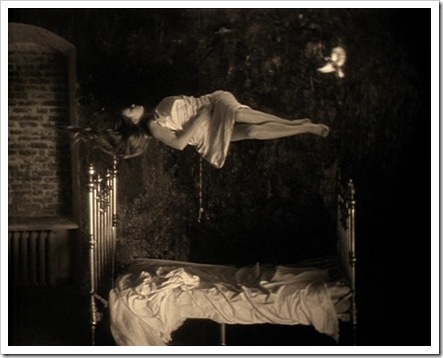
Or the levitation sequence: The mother was suspended in the darkness. The bird flung across, bringing the wind who swept across the bushes again. The house stood by its own. Inside, dangling laced curtain, tablecloths made way to a mirror lit by candle, where the child stood holding a disproportionately large bottle of milk. He smelt it, knowing not what to do with it, looked helplessly around.
Or the breaking glass sequence: The door opened, window glass broken. A cockerel was jumping out. A strange wind swept again across the bushes, blew down a big loaf of black bread and the paraffin lamp on the wooden table. The boy was running out of fear. Behind him, flower pedals fell down like a rain.
What is a Tarkovskian image? There is nothing incomprehensible. Tarkovsky wrote, “How does time make itself felt in a shot? It becomes tangible when you sense something significant, truthful, going on beyond the events on the screen; when you realise, quite consciously, that what you see in the frame is not limited to its visual depiction, but is a pointer to something stretching out beyond the frame and to infinity; a pointer to life.”
As for the special needs of achieving a truthful significance in those dream sequence, Tarkovsky answered, “In cinema ‘opacity’ and ‘ineffability’ do not mean an indistinct picture, but the particular impression created by the logic of the dream: unusual and unexpected combinations of, and conflicts between, entirely real elements. These must be shown with the utmost precision. By its very nature cinema must expose reality, not cloud it.”
These unexpected combinations emerged from his poetic imagination is the key stone of a Tarkovskian style. For example, the relationship of his protagonists with the water is most exceptional: in Stalker, the man crouched on a small piece of earth midst a shallow river, where a stray dog passed by, watching him curiously; In Nostalgia, he walked through an emptied hot spring pool, holding a tiny candle on the brink of going out. This notorious obsession with water is discernible even in Steamroller and Violin, his diploma film: it is in a newly drenched plaza, still saturated with water, reflecting sunshine that our little boy is standing together with the crowd, watching the demolition of a derelict church. And there is always this horse coming from nowhere, eating apples spread all over the riverbed (in Ivan), or just stretching itself leisurely, demonstrating its amazing beauty (in Andre Rublev).
Instances like this in Tarkovsky’s film are innumerable. They pass beyond the usual sentimental manifestation by their ambiguity, by their often contradictory nature, as Tarkovsky admitted, “A true artistic image gives the beholder a simultaneous experience of the most complex, contradictory, sometimes even mutually exclusive feelings.” This commentary is echoed by Leonardo’s paintings, namely the young woman with a juniper, which he inserted into the father return sequence. Of course the same could be applied to Mona Lisa, whose charm come from this contradictory nature forever vacillating between beautiful and fiendish, frivolous and solemn, male and female.
Where is the mirror?
Although we are informed that the present title came only after the introduction of Natalia, it soon became the fulcrum of the plot. We might wonder, however, why this late-coming element turned out to be omnipresent in the finished film – it exists in all levels. Visually, everybody seems to linger around the mirror, especially Natalia, who is never far away from one of them – there are plenty in the apartment. The rich country doctor’s wife, when she is trying the earring on, naturally will look at the mirror – yes, vanity always goes hand in hand with cruelty. And the young Alexei, before the lamp went out, watch himself intensely. Judging by the lighting effect, one might easily conclude that the former demonstrate vanity (the white brightness of front ambient light) and latter a self discovery (reddish side-lighting simulating chimney fire). But what about the dream sequence where the kid holding a bottle a milk? Is a boy of that age already capable of any narcissism? And the fogged mirror where two women reach out from both sides? How to explain the meaning in the Spanish war documentary, there was a girl holding a broken mirror? Most significantly, at the doctor’s room, there are at least 13 mirrors of different sizes hanging on a single wall!
Mirror’s nature property is nothing but to reflect. And the only substance it is capable of reflecting is light, not faces. Face doesn't exist in the mirror. By reflecting light the mirror gets a unique attribute of creating virtual dimensions. And why this dimension has to be a spatial one? If we apply this concept from the space domain into the time domain, a visual temporal dimension is rendered. Thus the same woman living in different ages can meet and see each other. But not touch. The mirror, although transparent, is still a non-traversable barrier. And this barrier could be a cultural one, like the role played by Russia between oriental and occidental culture, a giant Janus.
The mirror could also be deemed as the correspondence between the characters. Using the same actress to play mother and wife is already a mirror construction. And this correspondence is quite subtle: referring and refusing reference at the same time. The narrator remarked to Natalia that “when I dream of her, she always has your face.” Then later when she was looking at old mother’s photos, she remarked in her turn, “She and I really look alike.” and the narrator respond this time with a negative answer “not at all.”
Same could be said about Ignat and Alexei. When he was helping his mother picking some coins on the floor, he said, “It all happened once before.” The next shot we see mother in the war time kneeling on the same corridor, trying to pick up some plank for firewood.
Even the father figure is mirrored. I have reason to believe that the patient on the bed, the narrator, is played by Oleg Yankovsky, the same one who played the father.
Apparently mirror is being used by Tarkovsky as an expression on which one can add all kinds of adjectives. In Alexei’s contemplation, there is even a mirror in the burning charcoal. It is followed by yet another mirror, this time of a wardrobe, closed by an anonymous hand, revealing the redhead girl, the object of his burning desire, sitting near the fire, in pyjama.
However, to apply the idea of mirror to every moment of this film is not my intention. Mirror is indeed one of Tarkovsky’s favourite prop. Like water, fire, mirror is of highly symbolic value but in the same time remains one of the most common household items. Its omnipresence simply symbolize the persistence of memory, to the patient it becomes a guilt keeping haunting him like the wounded bird found on his bedside. It corresponds to a profound idea of artistic creation: not to construct, but to reflect, to reveal.
Pathology of dyslexia
Tarkovsky always had this illusion of being a kind of cinematographic messiah, that his unswerving dedication to image is just a road leads to higher necessities: to separate “light from darkness, and land from water”. That is why in Sculpting Time, he spent an unnecessarily large part treating certain issues with undue seriousness. And in doing so he exposes his verbal inaptness and fills us with this sympathy of his dyslexic suffering. Look at these chapter titles:
“Art – a yearning for the ideal.”
“Cinema’s destined role.”
“The artist’s responsibility.”
Is there a responsibility for the artists other than making good art? Or is there one for them to write a book about the responsibility of artist? Cinema’s destined role? Am I mistaken or it is an official of Goskino lecturing on the necessity of educating people with film – a effective mass medium before the days of television? Yes, he was surrounded by those meetings characterised by “Comrades, as you all know, the cinema’s destined role…” And he involuntarily murmured “We artists, our responsibility is …”
This is all perfectly understandable and even extremely familiar for me. As Natasha Synessios rightfully pointed out, “If Tarkovsky came to view himself as a prophet and a possessor of genius, he was aided by a culture that traditionally demanded that its artists be nothing less.” The dyslexia is mostly inevitable from an intellectual brought up in a communist background where since everybody has the same lameness, the particular case of yours goes without being noticed. As for the outsiders, lacking this suffocating experience would make them take for granted that the artist preferred to expose himself like this. For them this phenomenon of voice without individuality is unheard of. And it is hard for them to imagine that the official language, the public vocabulary has such a determinative power which individual couldn't possibly resist. I couldn't envy Tarkovsky of having an “ideal” of illuminating people which I struggled for years to get rid of. But I couldn't envy either this so-called post-modern empty and cruel world which our contemporary artists find themselves being thrown in: now is there any motif exist other than the fulfillment of personal ambition and material needs?
******
Tarkovsky’s talent is not his philosophy – which he had nothing new to say, and what he had said, he put them in a confused way typical of person of visual but not verbal orientation. The power of Mirror came not from what he is trying to say, but the way he visualizes them. If we use the conventional way of evaluating a film, or any oeuvre d’art, by its metaphysical dimension, by its psychological insight, by its meticulous craftsmanship and so on, we are on the wrong track (even though this film is quite impeccable in these aspects). That is why when those critics, especially those from a literature tradition, tried to consider him inside an infinitely more vast background, that is, the Russian thought, their efforts are destined to fail. Those external references do help to explain his motif, but never his talent. Or it is I who is trying to explain his talent without knowing that it is an impossible task? Let us keep silence before a miracle.
Chronology of sequences
1. (Color)Ignat open the TV with no images.
2. (B&W)The curing of the stuttering.
3. Opening credits.
4. (Color)Mother on the fences – the passer-by, “Do I have to call my husband?” – The wind on the plain when he turned around.
5. The first poem: The First Meeting (Love) Burning barn in the rain.
6. (Desaturated color)Kid wake up. (Shining B&W)Wind sweep through the bushes; He then waked up again, murmured, “Papa”, witnessing a white robe flung over room.
7. The first appearance of Father: he was naked. Mother in the night gown. The ablution sequence. Note when the ceiling started falling down, the window is half opened, and the lighting is noticeably enhanced, as well as the flame on the stove, accompanied by electronic music.
8. (Color) Camera dollyng in an empty apartment - conversation with mother on the phone: “last night I dreamt of you”.
9. (B&W) Mother running towards the print house: the imaginary error (the most flat sequence in the film, reminding nothing but those social realistic movies). Second poem: From Morning on I Waited Yesterday (Horror). Go for a bath.
10. (Color)Anonymous fire on the plain. Conversation with the wife: “I always said you resembled my mother.”
11. Kids being carried into the old house.
12. The wife is always in front of the mirror, “when I dream of her, she always has your face”.
13. Spanish friends. The first documentary: matador, bombing, parting children, allegro.
14. The second documentary: stratosphere balloons, Pergolesi’s Stabat Mater.
15. Ignat browsing a Leonardo book, talk with mother: “it all happened once before.”
16. Home alone. Reading letter of Pushkin (The most artificial sequence in the film). Old mother had the wrong apartment and she didn't recognize Ignat.
The trace of cup pad (Electronic music reminding Solaris). telephone from dad, the redhead girl. Purcell.
17. Shooting exercise, a white day.
18. The third documentary: Sivash footage. The third poem: Life, Life (Immortality).
19. The speckled boy went up onto the hill- (Pieter Brueghel: Hunters in the Snow).
The fourth documentary: war is over, Prague liberated, firework in Moscow, A. Bomb.
The bird stop on boy’s head.
The fifth documentary: culture revolution, crowd in Tiananmen Square, Mao, Sino-Russian border tumult.
20. Papa is back: where are the children? The second appearance of father: he was in uniform. Bach: St. Matthew Passion. Leonardo: Young woman with juniper(Genevra de Benci).
21. (B&W)The decision of Ignat. The photos of two mothers together, boy watching a small fire in the rain, “who showed himself in front of burning bush?”
22. (Color)Back to old house again. (B&W)In the trees. The breaking glass sequence.
23. (Color)Episode of selling earrings: Milk dripped to the floor. Alexei studies himself in front of the mirror, Bach. Mirror in the charcoal. A hand closes the mirrored wardrobe, revealing the redhead girl sitting near fire. An anonymous hand warms itself by a burning sprig.
24. The horror of killing a cockerel. (B&W) The third appearance of father. The levitation sequence: “I only see you when I am really sick.”
25. (Color)Mother and son are on the way home, pensive. The fourth poem: Eurydice (Soul & Body).
26. (B&W)
27. (Color)Daylight. Kid swimming, mother washing.
28. Long dolly from inside to outside, the old mother with two kids.
29. The doctor, the woman poet, the old servant. The narrator, now a patient with the strep throat is setting free a wounded bird on his bedside into the air (set me free, you haunting memories!).
30. Before the war, he asked her (The fourth appearance of father): “Do you want a boy or a girl?” She didn't answer.
31. Old mother with a basket of clothe took two kids together with her.
32. The mottled surface of rock, broken tree trunk, vestiges in a small pit, accompanied by Bach: Opening chorus of St. John Passion.
33. Old mother with two kids, without the basket.
34. The young mother is crying.
35. Old mother with two kids are crossing the plain, where the anonymous fire showed (see 10).
36. After the ululation of Alexei, everything is silent. The camera retreat into the deep forest while the old mother and two children walk towards the future.
Bibliography
A. Tarkovsky, Sculpting in time, Reflections on the Cinema. London: Bodley Head, 1986.
A. Tarkovsky, Collected Screenplays. London: Faber&Faber, 1999
Mark Le Fanu, The Cinema of Andrei Tarkovsky. London: BFI, 1987
Maya Turovskaya, Tarkovsky, Cinema as Poetry. London: Faber&Faber, 1989
Natasha Synessios, Mirror. London: L.B. Tauris, 2001

